Signs Your Child is Ready for a Football Academy
One of the most common mistakes Nigerian parents make with a talented young footballer is moving too quickly.
The excitement of seeing a child do something well, combined with the genuine desire to give them every possible opportunity, can push families toward academy enrollment before the child is actually ready for what that environment demands.
Moving too quickly does not just waste money. It can damage a child’s relationship with football entirely.
A player placed in an environment they are not ready for emotionally, physically, or technically tends to struggle in ways that shake their confidence at exactly the age when confidence is most fragile and most important.
On the other side, waiting too long has its own costs. A genuinely ready player who stays in an unstructured environment past the point where they need more challenge stops developing at the rate they should.
Recognising readiness accurately and acting on it at the right time is one of the most valuable things a football parent can do.
These are the signs that tell you your child is genuinely ready.
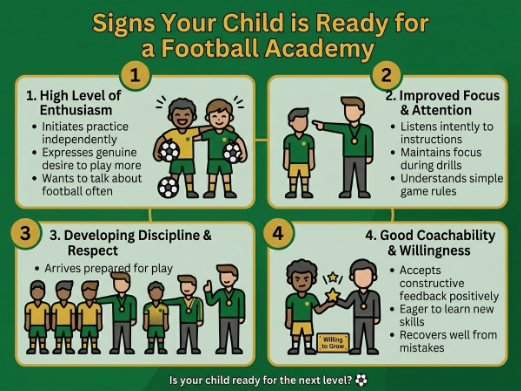
They Are Asking for More Than Casual Play Offers
There is a meaningful difference between a child who enjoys football and a child who is genuinely driven by it. Most Nigerian children enjoy football.
They play in the street, they join neighbourhood kickabouts, they watch matches with passion. That enjoyment is real and valuable but it is not by itself a sign of academy readiness.
The child who is ready for an academy is the one who is already seeking more structure than casual play provides. They are asking about joining a proper team.
They are watching football with a different quality of attention, studying how players move and make decisions rather than just enjoying the spectacle.
They are practicing alone when no one organised anything. They are frustrated by the limitations of street football because the level of challenge is no longer enough.
When a child is pulling toward more serious football rather than being pushed toward it by their parents, that internal motivation is one of the clearest signs of readiness.
They Handle Losing and Criticism Without Falling Apart
Football development involves a continuous stream of correction, criticism, and failure. Coaches will point out mistakes repeatedly.
Training will expose weaknesses. Matches will be lost. Players who cannot handle these experiences without becoming discouraged, withdrawn, or resistant to coaching will not thrive in an academy environment regardless of their technical ability.
Watch how your child responds when things go wrong during casual play.
Do they bounce back quickly from mistakes or do they sulk for extended periods?
Do they accept suggestions from older players or coaches or do they become defensive?
Do they keep trying when a skill is not coming easily or do they give up and move to something they can already do well?
A child who shows genuine resilience in the face of difficulty and who responds to correction with effort rather than resistance is showing you something important about their readiness for the demands of a serious development programme.
Their Technical Foundation Is Solid Enough to Build On
Academy coaches are not looking for finished technical products in young players. They are looking for raw material with a strong enough foundation to be developed.
But there is a baseline of technical ability below which a child will struggle to keep up with the pace of academy training and will spend most of their time trying to catch up rather than genuinely developing.
A child who is ready for an academy can control the ball with both feet reasonably well under mild pressure. They can pass the ball accurately over short distances.
They understand the basic concept of their position and make some reasonable decisions during play rather than simply chasing the ball wherever it goes. They show some awareness of teammates and opponents during a game rather than operating entirely in isolation.
These are not high bars. They are the basic technical competencies that allow a child to benefit from proper coaching rather than just struggling to manage the fundamentals while everyone else is working on higher level skills.
They Are Physically Ready for the Demands
Football academy training is physically more demanding than casual play in ways that catch underprepared children off guard. Sessions are longer, more intense, and more continuous than the informal football most children are used to.
Recovery between sessions becomes a real consideration. The physical demands of competitive matches at academy level are meaningfully higher than neighbourhood games.
A child who tires very quickly during sustained activity, who gets injured frequently during normal play, or who is significantly behind their peers physically in ways that suggest developmental concerns rather than just natural variation may benefit from more time before entering a structured academy programme.
This is not about size or athleticism in isolation. Nigerian football has produced exceptional players of all physical profiles. It is about whether the child’s body is robust enough to handle consistent structured training without breaking down or being overwhelmed by the physical demands before they have had a chance to develop.
They Can Separate From You Without Significant Distress
For day academies this matters less, but it matters more than most parents acknowledge even in that context. Academy training requires a child to operate independently within a group of peers and coaches for extended periods.
A child who becomes very anxious away from their parent, who struggles to function in new social environments, or who has difficulty following instructions from adults who are not their parents will find the academy environment genuinely stressful in ways that undermine their football development.
For boarding academies this consideration becomes central. A child who is not emotionally ready to live away from home will spend their energy managing homesickness and anxiety rather than developing as a footballer. No amount of talent compensates for that kind of emotional unreadiness at a young age.
A child who is socially confident, who makes friends reasonably easily, who can follow instructions from coaches and other adults without needing their parent present, and who handles new environments with curiosity rather than anxiety is showing you the emotional readiness that academy life requires.
They Understand What They Are Signing Up For
This sign is often overlooked entirely. A child who is genuinely ready for a football academy has some realistic understanding of what it involves.
Not a complete picture, because that only comes with experience, but a basic grasp of the fact that it means consistent hard work, following instructions, training even when they do not feel like it, and committing to something beyond casual play.
Have an honest conversation with your child about what academy football actually looks like. Describe the training schedule, the discipline required, the fact that a coach will correct them regularly and that they will need to respond positively to that correction. Ask them how they feel about those realities.
A child who responds with genuine enthusiasm and says yes, that is what I want is telling you something meaningful. A child who seems surprised by those realities or who qualifies their enthusiasm with a lot of conditions may need more time before the commitment makes sense for them.
When You Are Still Not Sure
If you have read through these signs and your child shows some but not all of them clearly, trust that uncertainty rather than pushing ahead anyway. A child who is almost ready benefits more from a few more months of informal development in a lower-pressure environment than from being placed in an academy before they are fully prepared.
The window for football development does not close as early as many Nigerian parents fear. A player who enters an academy at twelve fully ready will almost always outperform a player who entered at ten before they were ready. Readiness matters more than early entry.
When the signs are clear, act on them. Until they are clear, be patient. Your child’s football journey will thank you for it.
Written for Findin.com.ng | Parent Guides