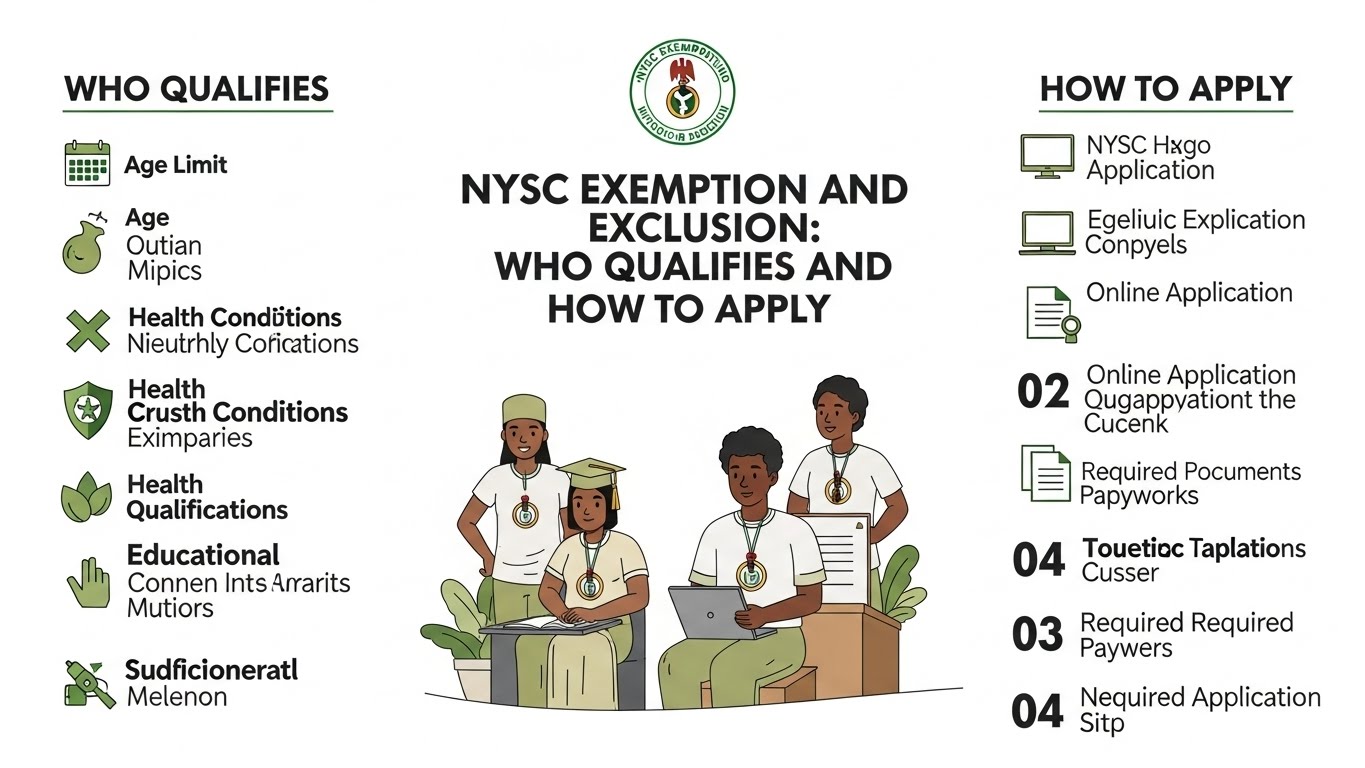
NYSC Exemption and Exclusion: Who Qualifies and How to Apply
Not everyone needs to serve NYSC. Some people qualify for exemption or exclusion. If you’re wondering whether you need to do the full one-year service or can get a certificate without serving, this guide explains everything.
Difference Between Exemption and Exclusion
Many people confuse these two terms. Here’s the difference:
NYSC Exemption
What it means: You were supposed to serve but you’re excused due to specific reasons
Who gets it:
- People who graduated after age 30
- Those with serious health issues
- People who served previously (if going for another degree)
What you get: Exemption certificate (serves same purpose as discharge certificate for employment)
NYSC Exclusion
What it means: Your qualification doesn’t require NYSC at all
Who gets it:
- Graduates of institutions not accredited by NYSC
- Holders of certain professional qualifications
- People with specific degree types not covered by NYSC Act
What you get: Exclusion letter or certificate
For employment purposes, both exemption and exclusion certificates work the same as discharge certificate.
Who Qualifies for NYSC Exemption?
1. Age Above 30 Years
If you’re over 30 at graduation, you qualify for exemption.
How age is calculated:
- Your age on the day you graduate (convocation date)
- NOT when you finished exams or defended project
- Your birth certificate or age declaration determines this
Example: If you were born in 1993 and graduated in 2024 (age 31), you qualify for exemption.
Important: If you turn 30 during service year (after mobilization), you must complete the service. Exemption only applies if you’re already 30+ at graduation.
2. Previous Service
If you already completed NYSC and went back for another degree:
Automatic exemption for:
- Second bachelor’s degree
- Master’s degree
- PhD or professional qualifications
Requirements:
- Original discharge certificate from first service
- New qualification certificate
- Proof that first NYSC was completed successfully
You cannot serve NYSC twice, even if you want to.
3. Medical/Health Reasons
Serious health conditions that make service impossible:
Qualifying conditions:
- Permanent physical disability requiring constant care
- Chronic mental health conditions
- Terminal illnesses
- Severe mobility impairments
- Conditions requiring continuous medical supervision
Requirements:
- Medical report from government hospital
- Doctor’s recommendation (on hospital letterhead)
- Medical board certification in some cases
- Supporting test results and evidence
Note: Simple health issues don’t qualify. It must be serious enough that you genuinely cannot serve for one year.
4. Parental Status (Limited Cases)
In rare cases, single parents with full custody might get exemption if:
- They have nobody to care for their child during service
- The child has special needs requiring constant presence
- Other exceptional circumstances
This is NOT automatic and rarely granted. NYSC prefers redeployment to exemption for such cases.
Who Qualifies for NYSC Exclusion?
1. Graduates from Non-Accredited Institutions
If your institution is not recognized by NYSC:
- Some foreign universities (especially online degrees)
- Institutions not accredited by NUC or NBTE
- Certain professional training centers
Check with NYSC office whether your institution requires NYSC before assuming you’re excluded.
2. Certain Professional Qualifications
Some professional certifications don’t require NYSC:
- ICAN (Institute of Chartered Accountants)
- Some legal qualifications
- Specific technical certifications
But if you have a bachelor’s degree alongside these, you still need NYSC for the degree.
3. HND After Age 30
Similar to bachelor’s degree age rule. If you’re over 30 at HND graduation, you get exclusion/exemption.
How to Apply for NYSC Exemption
Step 1: Gather Required Documents
Basic documents for all applicants:
- Completed NYSC registration form (get from NYSC portal or office)
- Original and photocopies of degree certificate
- Original and photocopies of academic transcript
- Birth certificate or sworn age declaration affidavit
- National ID card, voter’s card, or international passport
- Recent passport photographs (6 copies)
Age-based exemption (add these):
- Birth certificate (most important!)
- If no birth certificate: Age declaration affidavit from court
- School leaving certificate showing birth date
- National ID showing birth date
Medical exemption (add these):
- Medical reports from government hospital
- Doctor’s recommendation letter
- Test results and medical records
- Hospital ID card
- Medical board certification (if available)
Previous service exemption (add these):
- Original NYSC discharge certificate
- Call-up letter from previous service
- Evidence of completion of first service
Step 2: Visit NYSC Office
Go to your state NYSC office (or NYSC headquarters in Abuja):
- Don’t go to camp; go to state secretariat
- Arrive early (offices open 8am usually)
- Dress formally
- Bring all documents (originals and photocopies)
Step 3: Submit Application
At the exemption desk:
- Request exemption application form
- Fill it carefully and completely
- Attach all required documents
- Submit to the officer handling exemptions
- Collect acknowledgment slip or reference number
Step 4: Pay Required Fees (If Any)
Some states charge processing fees:
- Usually between ₦2,000 – ₦10,000
- Payment method varies by state
- Collect official receipt
Note: Official fees are usually low. If anyone asks for large amounts (₦50,000+), be suspicious.
Step 5: Processing Period
Wait for processing:
- Can take 2 weeks to 3 months
- Depends on state efficiency
- Follow up weekly by phone or visit
Step 6: Collect Your Exemption Certificate
When ready:
- You’ll be notified (by phone/email)
- Visit the office to collect
- Bring original ID and acknowledgment slip
- Verify all details on certificate before leaving
Documents Needed for Exclusion
Similar to exemption, but may require:
- Letter from your institution explaining why NYSC isn’t required
- Proof of accreditation status
- Professional body certification
- Other institution-specific documents
Contact NYSC directly for exclusion cases, as requirements vary.
Common Application Mistakes to Avoid
1. Wrong Age Calculation
- Don’t use age when you finished exams
- Use age at actual graduation/convocation
- If you’re 29 at graduation, you must serve (no exemption)
2. Fake Medical Reports
- Don’t exaggerate or fake health issues
- NYSC investigates suspicious medical claims
- Use only government hospital reports
- Consequences for fraud are serious
3. Incomplete Documentation
- Missing any document delays processing
- Make multiple photocopies of everything
- Keep original documents safe
4. Wrong NYSC Office
- Apply at your state of origin NYSC office
- Or NYSC headquarters in Abuja
- Don’t go to random state offices
5. Applying Too Late
- Apply immediately after graduation
- Don’t wait years (though it’s still possible)
- Early application = faster processing
Using Your Exemption Certificate
Your exemption certificate works like discharge certificate:
- Submit for job applications
- Use for professional registrations
- Required for government employment
- Valid for postgraduate admissions
- Needed for international processes requiring NYSC proof
Make multiple certified copies and scan it digitally.
What If Application is Rejected?
If your exemption is denied:
For age issues:
- If you’re truly over 30, appeal with stronger birth evidence
- Get age declaration from two different courts
- Provide school records showing consistent age
For medical issues:
- Get second opinion from another government hospital
- Request medical board review
- Provide more comprehensive medical documentation
General appeals:
- Write formal appeal letter
- Attach additional supporting evidence
- Submit to State Coordinator or Director General (Abuja)
- Be patient with appeals process
Cost of Exemption Process
Official costs:
- Application form: Free to ₦500
- Processing fee: ₦2,000 – ₦10,000 (varies by state)
- Certificate printing: Usually included
Unofficial costs you’ll likely incur:
- Transportation to NYSC office (multiple trips)
- Photocopying documents: ₦500 – ₦2,000
- Affidavits (if needed): ₦2,000 – ₦5,000
- Medical reports (if applicable): ₦5,000 – ₦20,000
Total realistic budget: ₦15,000 – ₦50,000
Anyone asking for ₦100,000+ is likely scamming you.
Exemption vs Serving: Which is Better?
Advantages of Exemption:
- No wasting one year
- Start work/business immediately
- No camp stress
- No relocation from your base
Advantages of Serving:
- Networking opportunities
- Experience and exposure
- Some employers prefer those who served
- Personal growth and memories
- Monthly allowance for one year
If you qualify for exemption but can still serve, consider your situation carefully. NYSC experience has value beyond the certificate.
Frequently Asked Questions
Can I choose exemption if I’m under 30? No. If you’re under 30 and healthy, you must serve.
What if I turn 30 during service year? You must complete the service. Exemption only applies if you’re 30+ at graduation.
How long does exemption certificate last? It’s permanent. No expiry date.
Can I get exemption for financial hardship? No. Financial issues don’t qualify for exemption.
What if I’m pregnant? Pregnancy doesn’t qualify for exemption. You can defer (postpone) or get redeployed for easier service.
Do I need to go to Abuja for exemption? Not usually. Your state NYSC office handles it. Only complex cases might need Abuja.
Can I work while waiting for exemption certificate? Yes, but some employers want to see the certificate first. Explain your situation to them.
Is exemption certificate different from discharge certificate? They look different but serve the same purpose for employment and other official uses.
Final Tips
- Confirm your eligibility first – don’t waste time if you don’t qualify
- Gather all documents before starting – incomplete applications take longer
- Be honest in your application – fraud has serious consequences
- Follow up regularly – don’t just submit and forget
- Keep copies of everything – all documents and receipts
- Be patient – bureaucracy is slow, but it works eventually
If you genuinely qualify for exemption, the process is straightforward. Just follow the steps carefully and provide complete documentation.
Good luck with your application!