NYSC Batch A, B, C: Differences and Which is Best
NYSC operates three batches every year – Batch A, B, and C. If you’re wondering which batch you’ll be in, what the differences are, or which is best, this guide breaks it down.
What Are NYSC Batches?
NYSC batches are the three different mobilization periods each year. Instead of mobilizing all graduates at once, NYSC divides them into three groups based on when they graduated.
Why batches exist:
- Makes orientation camp management easier
- Allows for better resource allocation
- Ensures continuous flow of corps members
- Helps states plan for corps member accommodation
Each batch goes through the same process: registration → orientation camp → PPA → service year → passing out.
NYSC Batch Timeline
Batch A (Stream 1)
Mobilization: February/March Orientation Camp: March/April (3 weeks) Service Year: April – March (next year) Passing Out: March/April (next year)
Who is mobilized:
- Graduates from July – October (previous year)
- Students who completed their programs in those months
Registration Opens: Usually November/December
Batch B (Stream 2)
Mobilization: July/August Orientation Camp: July/August/September (3 weeks) Service Year: August/September – July/August (next year) Passing Out: August/September (next year)
Who is mobilized:
- Graduates from November – March
- Students who finished between these months
Registration Opens: Usually April/May
Batch C (Stream 3)
Mobilization: November/December Orientation Camp: November/December (3 weeks) Service Year: December – November (next year) Passing Out: November/December (next year)
Who is mobilized:
- Graduates from April – August
- Students who completed programs in these months
Registration Opens: Usually August/September
Note: Exact dates vary slightly each year. Always check NYSC official website for current batch dates.
How to Know Your Batch
Your batch depends on your graduation date (not when you finished exams):
Check these:
- Your certificate issue date
- Date of final clearance from school
- Senate-approved graduation list date
- When your institution releases you for NYSC
Example:
- Graduated in August 2024 → Batch C 2024
- Graduated in January 2025 → Batch B 2025
- Graduated in September 2024 → Batch C 2024 or Batch A 2025 (depends on when school releases you)
If your graduation falls between batches, you might be able to choose which batch to join by registering early or late.
Batch A Characteristics
Pros:
✅ Best weather at camp – March/April is usually dry and less hot
✅ New year energy – Fresh start, lots of motivation
✅ Graduate programs start around your POP – Good for those planning Masters
✅ Companies recruit heavily – Many organizations have budget for new hires early in the year
✅ Good for job hunting – You pass out when companies are hiring most
Cons:
❌ Harmattan dust in some states – Northern states especially
❌ Post-Christmas broke – Many corps members are cash-strapped after December holidays
❌ Academic calendar conflicts – Some schools are still on holiday when camp starts
❌ Highest competition for PPAs – Most graduates in this batch
Best for: People who want to start job hunting immediately after service, those planning further studies
Batch B Characteristics
Pros:
✅ Longest break before mobilization – Graduate in March, serve in July (4 months free time)
✅ Rainy season – Cooler weather in many states
✅ Mid-year opportunities – Some companies hire mid-year
✅ Pass out before Christmas – Can travel home for holidays after POP
✅ Less competition – Smaller batch usually
Cons:
❌ Heavy rains during camp – Camp can be muddy and uncomfortable
❌ Flooding in some states – July-September is peak rainy season
❌ Service year spans two Decembers – You’ll be in service during two Christmas periods
❌ Pass out during “ember months” – Companies are winding down, less hiring
Best for: People who want a long break after graduation, those who don’t mind rainy season
Batch C Characteristics
Pros:
✅ Ember months allowance – You get paid during November/December festivities
✅ Christmas at camp/PPA – Some find this fun, others not so much
✅ Pass out before another Christmas – Service ends before next December
✅ New year job opportunities – You finish just as companies are hiring in January
✅ Shorter wait after graduation – Graduate in August, serve in November (3 months)
Cons:
❌ Camp during harmattan – Dusty, dry, cold mornings in northern states
❌ Christmas away from home – You’ll be at camp or PPA during holidays
❌ Year-end rush – Camp coincides with festive period planning
❌ Smaller batches sometimes – Fewer mobilized compared to A and B
❌ Budget constraints – Government and companies winding down for year-end
Best for: People who want to finish school and start service quickly, those who don’t mind missing Christmas at home
Which Batch is Best?
Honest answer: It depends on your personal situation.
Choose Batch A if:
- You want to job hunt immediately after service
- You prefer dry weather
- You’re planning Masters/PhD applications
- You want to finish before next rainy season
Choose Batch B if:
- You want a long break after graduation
- You don’t mind rainy season
- You want to pass out before Christmas
- You prefer smaller, less crowded batches
Choose Batch C if:
- You want to start service quickly after graduation
- You’re okay missing Christmas at home
- You want to finish and start job hunting in January
- You prefer cooler weather (harmattan)
Reality check: Most people don’t get to choose. Your graduation date determines your batch automatically.
Can You Change Your Batch?
Officially: Very difficult and rarely allowed
NYSC determines your batch based on when your school releases you. However:
Possible scenarios for batch change:
Delaying to next batch:
- Don’t register when your batch opens
- Register for the next batch instead
- Risk: Your school might send your details automatically
- You might face questions about the delay
Moving forward to earlier batch:
- Almost impossible
- NYSC is strict about this
- Your school credentials determine eligibility
Deferment:
- If you have valid reasons (health, pregnancy, etc.)
- You can defer to next batch or the one after
- Requires proper documentation and approval
Warning: Don’t try to manipulate the system. If caught, you might:
- Be asked to repeat service
- Face disciplinary action
- Have issues with your discharge certificate
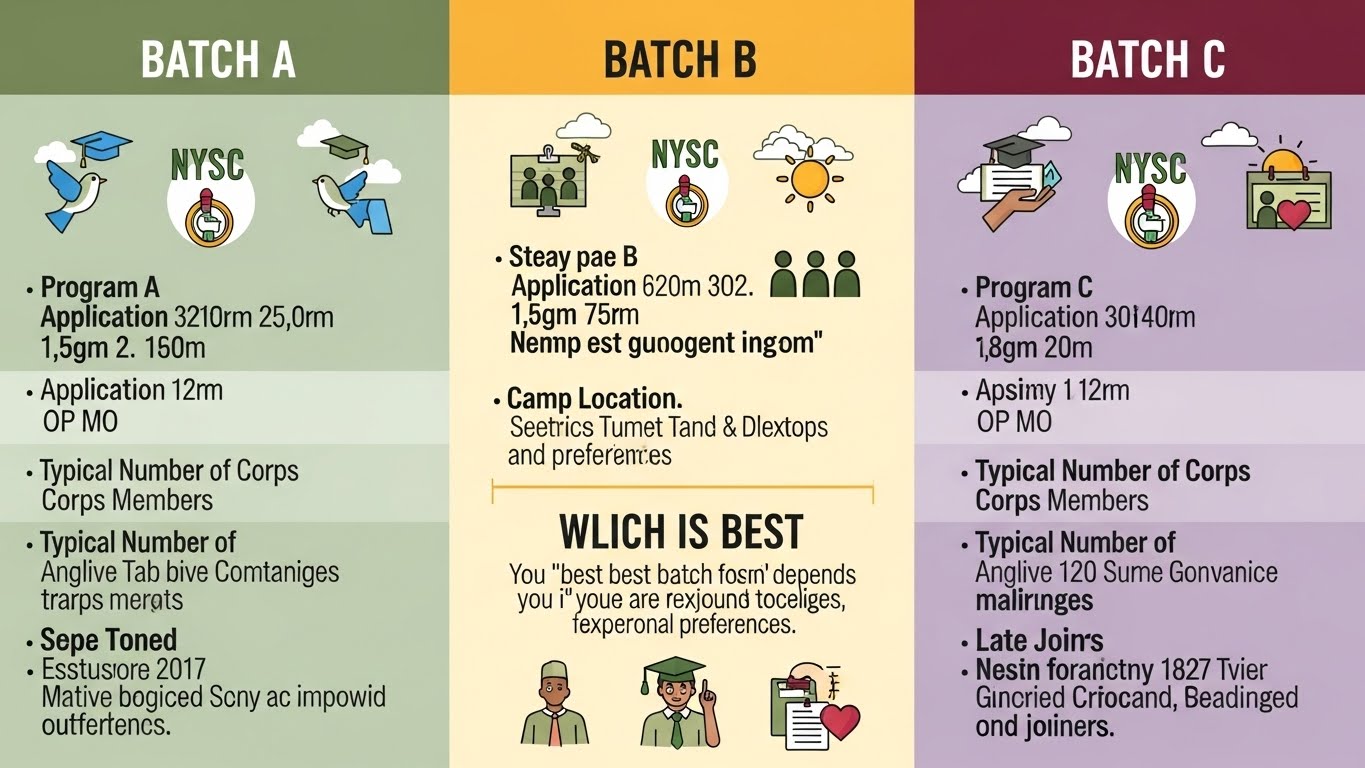
Batch Size and Competition
Typical batch sizes (approximate):
- Batch A: Largest (40-45% of annual corps members)
- Batch B: Medium (30-35% of annual corps members)
- Batch C: Smallest (20-30% of annual corps members)
What this means:
- Batch A has most competition for good PPAs
- Batch C has fewer corps members competing
- Larger batches = more networking opportunities
- Smaller batches = more personalized attention at camp
Weather Conditions by Batch
Batch A (March-April)
Southern States: Dry, getting hot, minimal rain Northern States: End of harmattan, dusty, warm days, cool nights Overall: Generally comfortable
Batch B (July-August)
Southern States: Heavy rains, muddy camps, cooler but humid Northern States: Rainy season, moderate temperatures Overall: Wet and uncomfortable for many
Batch C (November-December)
Southern States: Dry season beginning, cooler weather Northern States: Peak harmattan, very dusty, cold mornings, hot afternoons Overall: Dry but dusty, temperature extremes
Pack accordingly for your batch’s weather!
Allowance Payment Timing
Batch A:
- First payment usually May/June
- Regular payments through service year
- Final payment April/May next year
Batch B:
- First payment usually September/October
- Payments through service year
- Final payment September/October next year
Batch C:
- First payment usually February/March
- Might face delays if budget isn’t approved
- Final payment January/February next year
All batches face similar 2-3 month delay before first payment.
Post-NYSC Opportunities by Batch
Batch A (Pass out March/April):
- Good timing for job applications
- Companies recruiting for Q2 positions
- Masters programs admissions open
- Professional exams usually scheduled
Batch B (Pass out August/September):
- Q4 recruitment is slower
- Some companies focus on year-end closing
- Can use ember months to upskill
- January recruitment is active
Batch C (Pass out November/December):
- Year-end, less active hiring
- January recruitment picks up
- Good time to prepare applications
- New year opportunities ahead
Frequently Asked Questions
Can I serve with my friend in same batch? Only if you both graduate in periods that qualify for same batch. You can’t force it.
What if I missed registration for my batch? You’ll automatically move to the next batch. Just register when that batch opens.
Which batch has easiest camp? All camps are similar in structure. Weather is the main difference, not difficulty.
Can married couples serve same batch? Yes, if both qualify for that batch’s mobilization period. Apply for redeployment to same state.
Do some batches get posted to better states? No. State posting is random across all batches.
Which batch finishes fastest? All batches serve the same 11-12 months. The calendar timing just differs.
Can I join a batch if I graduated years ago? Yes, but you’ll be placed in the next available batch after you register.
Tips for Every Batch
Regardless of your batch:
Before Camp:
- Register early when portal opens
- Gather all documents in advance
- Research your deployment state
- Join your batch WhatsApp groups
During Service:
- Network with corps members from all batches
- Focus on learning and growth
- Build relationships at your PPA
- Save some allowance
After Service:
- Start job hunting before POP
- Keep in touch with useful contacts
- Update your CV with NYSC experience
- Plan your next move carefully
Final Thoughts
Your batch doesn’t determine your success during NYSC. What matters is:
- Your attitude and effort
- How you network and learn
- The relationships you build
- The value you add at your PPA
Some of the best NYSC experiences happen in “difficult” batches, and some people struggle even in “favorable” batches.
Focus on making the most of whichever batch you’re in. The experience is what you make it!
Safe service year, Corper!