How to Know if Football Boots Are Fake When Buying in Nigeria
Nigeria has one of the most active counterfeit sports goods markets in Africa.
Walk through any major market in Lagos, Kano, Aba, or Onitsha and you will find stalls selling what appear to be Nike Mercurials and Adidas Predators at prices that seem almost too good to be true.
Sometimes they are genuine clearance products. Most of the time they are not.
The fake boot industry in Nigeria is sophisticated enough that casual inspection no longer reliably separates genuine products from counterfeits.
The stitching looks clean. The branding appears correct. The box looks official. And then three weeks into academy training the sole starts separating, the upper cracks, and the player is back to square one having spent money that could have gone toward a genuine product.
This guide gives you the specific things to check before handing over your money for any football boot in Nigeria, whether you are buying in a physical market, from a social media seller, or through an online platform.
Start With the Price
The most reliable first signal that something is wrong is a price that does not make sense.
Genuine Nike and Adidas football boots at the mid-range and elite tiers cost what they cost because of the materials, technology, and quality control that go into making them.
A pair of boots being sold at 40 percent or 50 percent below the standard market price for that model is almost certainly not genuine.
This does not mean the cheapest boots are always fake. Entry level and training tier boots from genuine brands are genuinely less expensive than elite models.
But if someone is offering you what appears to be an elite model at an entry level price, the explanation is almost never that you have found a remarkable bargain.
The explanation is almost always that the product is counterfeit.
Know the realistic price range for the specific model you are buying before you go shopping.
Research what authorised retailers like AFA Sports and MySportsKit NG charge for that model and use that as your baseline. Any seller offering the same model at a significantly lower price deserves serious scrutiny before you hand over any money.
Check the Packaging Carefully
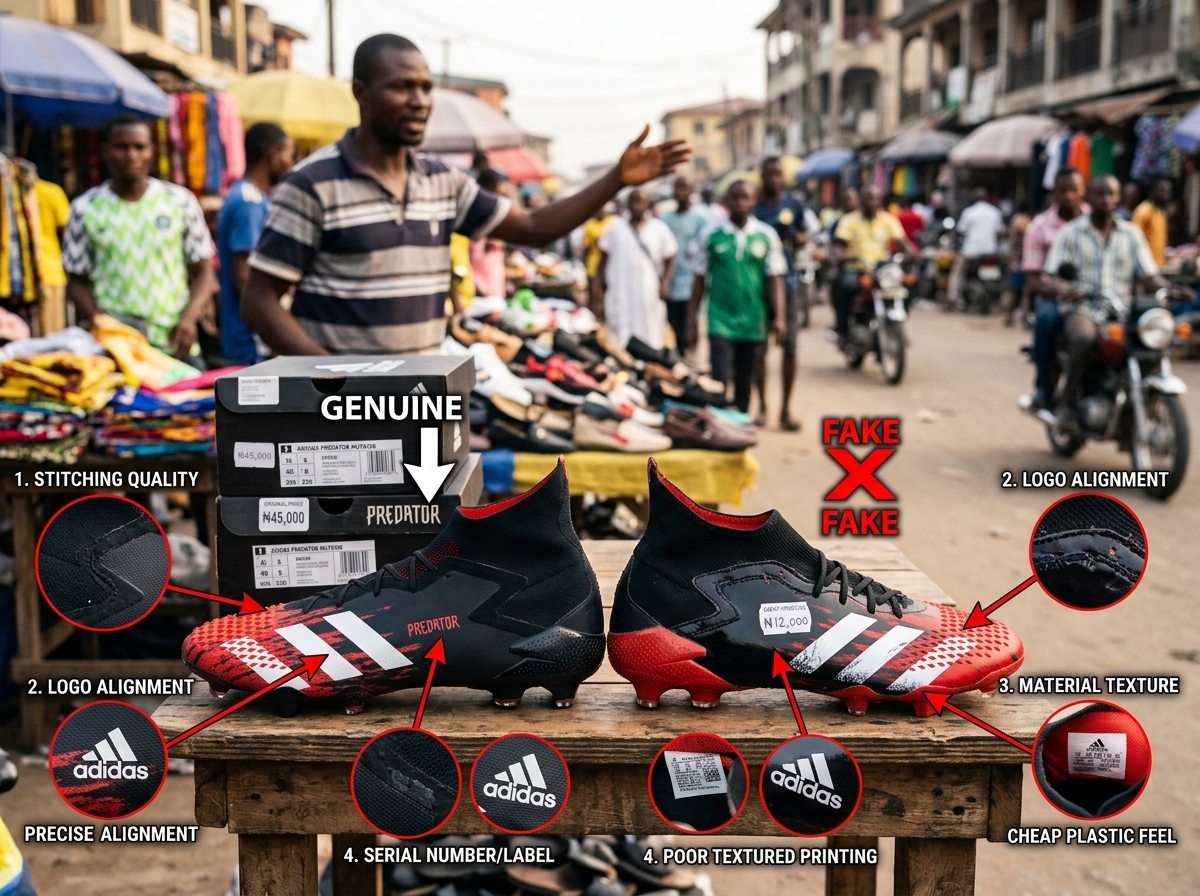
Genuine football boots from Nike and Adidas come in specific branded boxes with consistent design standards that counterfeit producers struggle to replicate perfectly.
Here is what to examine on the box before even opening it.
The printing quality on a genuine box is sharp, consistent, and clean. Colours are vivid and accurate. Text is crisp with no blurring or slight misalignment.
Counterfeit boxes often have slightly faded colours, text that is marginally off in font weight or spacing, or printing that looks slightly blurry when examined closely.
The barcode on a genuine box scans correctly and matches the product information on the box. Several free barcode scanner apps are available on Android and iPhone.
Scan the barcode on the box and verify that the product information it returns matches what is printed on the box itself. A mismatch or a barcode that does not scan at all is a significant red flag.
Genuine boxes have a consistent, slightly glossy finish on the exterior.
Counterfeit boxes are sometimes printed on slightly different paper stock that feels thinner or has a different texture when you handle it.
Check that the size, colourway, and model information printed on the box matches exactly what is inside the box. Counterfeit operations sometimes mismatch boxes and boots, particularly when they are assembling mixed stock quickly.
Examine the Boot Itself
Once you have opened the box, the boot itself needs careful examination before you accept it as genuine.
The tongue and lining. Run your finger along the inside lining of the boot. Genuine boots have smooth, consistent interior finishing with no rough edges, exposed stitching ends, or areas where the lining material is pulling away from the upper. Counterfeit boots often have rough interior finishing that becomes uncomfortable during extended training and that deteriorates quickly.
The stitching. Examine the stitching across the entire upper of the boot. Genuine boots have tight, even stitching with consistent spacing between each stitch. Counterfeit boots often have stitching that varies in tightness, has loose thread ends that were not properly finished, or shows slight waviness rather than running in clean straight lines.
The branding details. Nike’s swoosh and Adidas’s three stripes are the most replicated elements in the counterfeit boot market and also the ones that counterfeit producers get slightly wrong most consistently. On a genuine Nike boot, the swoosh has a specific curve, thickness gradient, and finish that is consistent across the entire logo. On a genuine Adidas boot, the three stripes are perfectly parallel, consistently spaced, and cleanly finished at both ends. Examine these elements closely. Even small deviations from the correct proportions and finish are significant.
The soleplate. Turn the boot over and examine the soleplate carefully. On genuine boots the soleplate is firmly attached to the upper with no separation or lifting at the edges. The studs on genuine boots are moulded consistently with clean edges and uniform finish. Counterfeit soleplates often show slight separation at the edges where the bonding is already compromised before the boot has been worn at all, and stud edges are sometimes rough or slightly irregular in shape.
The weight. Genuine football boots at every price point are engineered to specific weight targets and feel balanced in the hand. Counterfeit boots are often noticeably heavier than genuine versions of the same model because inferior materials are used in larger quantities to compensate for their lower quality. If you have access to a genuine version of the boot you are examining for comparison, hold both and notice any weight difference.
Verify the Serial Number
Most genuine Nike and Adidas football boots have a serial number printed on the tongue label or inside the boot. This number can be used to verify authenticity through the brand’s official channels.
Nike has an official verification process through their website and customer service channels. Adidas similarly provides authenticity verification options. If a seller is reluctant to allow you time to verify a serial number before completing a purchase, treat that reluctance as a significant warning sign.
Be Especially Careful on Social Media
Social media has become one of the primary channels through which counterfeit football boots are sold in Nigeria. Instagram and WhatsApp in particular are filled with vendors posting attractive images of boots at prices that generate immediate interest, collecting payment through bank transfer, and either delivering counterfeits or disappearing entirely after payment is made.
The images used in these social media listings are almost always taken from genuine retailer websites or brand pages and tell you nothing about the actual product being sold. The boots in the picture are real. The boots you receive may not be.
Before buying from any social media vendor, verify that they have a physical address you can visit.
Ask for a video of the specific pair you are buying, not stock images, showing the packaging, the boot details, and the serial number clearly.
Check whether they have verifiable reviews from buyers who have purchased and received products, not just followers or post engagement.
Ask established members of the Nigerian football community whether they have experience with that specific vendor.
A vendor selling genuine products will have no problem providing all of this information. A vendor selling counterfeits will find reasons to avoid it.
The Aba Question
Aba in Abia State deserves specific mention because it is the centre of Nigeria’s counterfeit sports goods manufacturing industry. Aba-made football boots are sometimes sold openly as locally manufactured alternatives, which is honest, and sometimes sold as genuine Nike or Adidas products, which is fraud.
Aba-made boots are not automatically terrible products. Some offer reasonable durability at low prices for players who genuinely cannot afford genuine brands.
But they are not the same as genuine branded boots and should never be sold or purchased as if they are. If a seller in any Nigerian market cannot clearly tell you whether a boot is a genuine imported product or a locally manufactured one, walk away.
What to Do if You Realise You Have Bought Fake Boots
If you complete a purchase and later realise the boots are counterfeit, your options depend on where you bought them.
From a physical market seller, your practical options are limited. Market sellers of counterfeit goods are not going to offer refunds and pursuing the matter through formal channels is rarely practical for a single boot purchase.
From an online platform like Jumia, use their official dispute and return process immediately.
Document the specific signs of counterfeiting with photographs and submit a detailed complaint. Jumia’s buyer protection policies cover counterfeit goods and they have an interest in removing counterfeit sellers from their platform.
From a social media vendor, report the account to the platform and to the Nigerian Consumer Protection Council if the amount involved justifies it. Bank transfer fraud for counterfeit goods is technically actionable under Nigerian law though pursuing it individually is difficult.
The most effective protection against fake boots is the research you do before you buy. Take your time, ask the right questions, examine everything carefully, and do not let urgency or an attractive price override your judgment. Your child’s development deserves genuine equipment.
Written for Findin.com.ng | Player Guides