How to Break in New Football Boots Without Getting Blisters
There is a specific kind of pain that every footballer knows. You have just bought a new pair of boots, you are excited to wear them, you put them on for the first training session, and by the end of the session you have blisters in three places, your heels are raw, and you are limping back to the changing area wondering why nobody warned you about this.
The breaking in process is something most Nigerian players and parents discover the hard way. This guide exists so you do not have to.
Why New Boots Cause Blisters
Understanding why new boots cause blisters makes the solution easier to implement consistently.
New football boots, regardless of brand or price point, are stiff. The upper material, whether leather or synthetic, has not yet conformed to the specific shape of the wearer’s foot.
The areas where the boot’s structure meets the foot create friction points during movement and it is that repeated friction, multiplied across thousands of steps during a training session, that produces blisters.
The areas most commonly affected are the back of the heel where the heel counter meets the Achilles tendon area, the little toe where the outer edge of the boot can press against it during lateral movement, the top of the toes where the boot upper presses down during kicking actions, and sometimes the instep where lacing creates pressure points during extended play.
Breaking in boots means gradually softening and shaping the upper material so that these friction points are eliminated before the boots are worn for a full training session or match.
The Fundamental Rule of Breaking In
Never wear brand new boots for the first time during a full training session or a competitive match. This is the single most important rule and the one that most players break because they are too excited about their new boots to be patient about it.
Wearing new boots straight into a full session is how serious blisters happen. Blisters bad enough to require days of rest. Blisters that can sideline a player at exactly the wrong moment before a trial or an important match. The patience required to break in boots properly is genuinely worth it.
Step One: Wear Them Around the House First
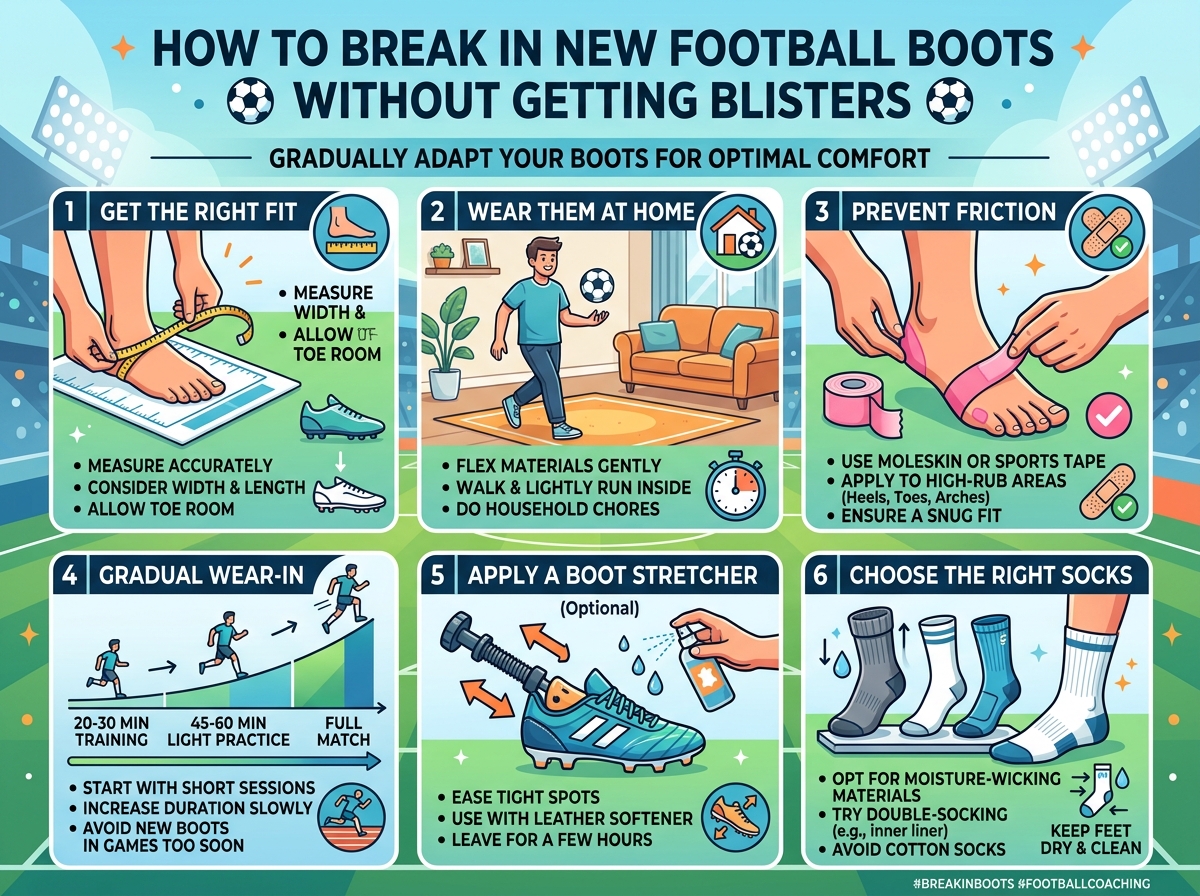
The first stage of breaking in new football boots begins at home, not on a pitch. Put the boots on with your training socks and wear them around the house for thirty to forty five minutes at a time over several days. Walk around, flex your feet, move naturally.
This sounds almost too simple to be worth doing but it serves an important purpose. It begins the process of the upper material conforming to your foot’s specific shape in a low-friction environment where blisters cannot develop because you are not generating the sustained high-intensity movement that causes them.
During these home wearing sessions, pay attention to where you feel pressure or tightness. Those are the areas that need the most attention during the breaking in process and identifying them early allows you to address them specifically.
Step Two: Use Petroleum Jelly on Problem Areas
Once you have identified the specific areas where the boot creates pressure or friction on your foot, petroleum jelly, which is widely and cheaply available across Nigeria, becomes your most important tool.
Before every wearing during the breaking in process, apply a generous amount of petroleum jelly to the specific areas of your foot that correspond to the pressure points you identified. The back of the heel, the little toe, the top of the toes, wherever you felt friction during the home wearing sessions.
The petroleum jelly reduces friction between your skin and the boot during movement. It does not eliminate the breaking in process but it dramatically reduces the severity of any blisters that develop while the boot is still stiffening up.
Some players also apply petroleum jelly directly to the interior surfaces of the boot at the friction points rather than to the foot. Both approaches work and combining them gives the best protection during the early stages of breaking in.
Step Three: Short Sessions on the Pitch
After several days of home wearing, move to short sessions on the pitch. Not full training sessions. Fifteen to twenty minutes of light activity, passing, gentle movement, basic technical work at low intensity.
This begins exposing the boot to the movement patterns of actual football in a controlled way. The flexing of the soleplate during kicking, the lateral pressure during changes of direction, the heel impact during running, all of these begin shaping the boot to your foot’s movement patterns without the sustained duration that causes serious blisters.
Keep the petroleum jelly application going during these short pitch sessions. Change back to your regular training footwear after the twenty minute breaking in period and complete the rest of your training in boots that are already broken in.
Do this across three to five separate sessions before attempting to wear the new boots for a full training duration.
Step Four: Gradually Extend the Duration
Once the fifteen to twenty minute sessions are producing no significant friction or discomfort, extend the duration gradually. Move to thirty minutes, then forty five, then a full session. At each stage, if significant friction or discomfort develops, drop back to the previous duration for a few more sessions before extending again.
The total breaking in process for most boots takes between one and two weeks of consistent gradual exposure. Some softer leather boots break in faster. Some stiffer synthetic boots take longer. The process cannot be rushed without consequences.
Dealing With Blisters That Develop During Breaking In
Even with proper technique, small blisters sometimes develop during the breaking in process. Knowing how to manage them properly prevents them from becoming serious enough to interrupt training.
Small intact blisters should be left alone wherever possible. The fluid inside a blister is the body’s natural protection for the damaged skin underneath and puncturing it prematurely removes that protection and increases infection risk.
Cover intact blisters with a proper blister plaster, which is available at pharmacies across Nigeria, before training. Blister plasters have a cushioned gel layer that reduces pressure on the blister during activity and allows training to continue without significantly worsening the injury.
If a blister breaks on its own, clean the area thoroughly with antiseptic, allow it to dry completely, and cover it with a sterile dressing before any further boot wearing. Keep the area clean and monitor it for signs of infection including increasing redness, warmth, or discharge.
Never puncture a blister with an unsterilised implement. The infection risk is not worth the temporary pressure relief.
The Warm Water Method
A technique used by many experienced players to accelerate the breaking in process involves warm water and is worth knowing about, though it requires care to do correctly.
Fill the boots with warm, not hot, water and allow them to sit for several minutes until the upper material has softened noticeably. Pour out the water, put on thick socks, and immediately wear the boots while they are still damp and softened, walking around and flexing your feet in all the directions that football demands.
As the boots dry while being worn, the upper material conforms to the specific shape of your foot rather than drying back to its original stiff form. This significantly accelerates the conforming process.
The risk of this method is that it can damage certain boot materials if done incorrectly, particularly some synthetic uppers and any boot with a knit construction. It is safest for traditional leather or standard synthetic leather boots. For boots with premium knit uppers like certain Nike Flyknit or Adidas Primeknit models, avoid the water method entirely and use the gradual approach only.
Never use hot water and never use a heat source like a hair dryer or direct sunlight to accelerate drying after the water method. Dry naturally at room temperature.
Blister Prevention Products Worth Knowing
Beyond petroleum jelly, several products help prevent blisters during the breaking in process and are worth having in your football kit bag.
Blister prevention sticks, which look like deodorant sticks and are applied directly to friction-prone skin areas, are effective and mess-free alternatives to petroleum jelly. They are less widely available in Nigerian markets than petroleum jelly but can be found at well-stocked pharmacies in major cities.
Double-layer socks designed specifically for blister prevention work by allowing the two layers to slide against each other rather than allowing the boot to slide against the skin. For players who are particularly prone to blisters, these socks are worth the investment.
Zinc oxide tape applied over blister-prone areas before training provides a protective layer between the skin and the boot. It is widely available at Nigerian pharmacies and is used by professional players worldwide for exactly this purpose.
The Patience That Makes It Worth It
Breaking in boots properly requires patience that feels frustrating when you have exciting new boots sitting in a box and a training session coming up. But the alternative, showing up to a trial or an important match with boots that are not broken in and developing serious blisters halfway through, is far more costly than the patience the process requires.
Give your new boots the time they need to become genuinely yours. The boots that have been properly broken in and have conformed to your foot feel like an extension of yourself during play in a way that new stiff boots never do. That feeling is what you are working toward and it is worth the patience to get there properly.
Written for Findin.com.ng | Player Guides