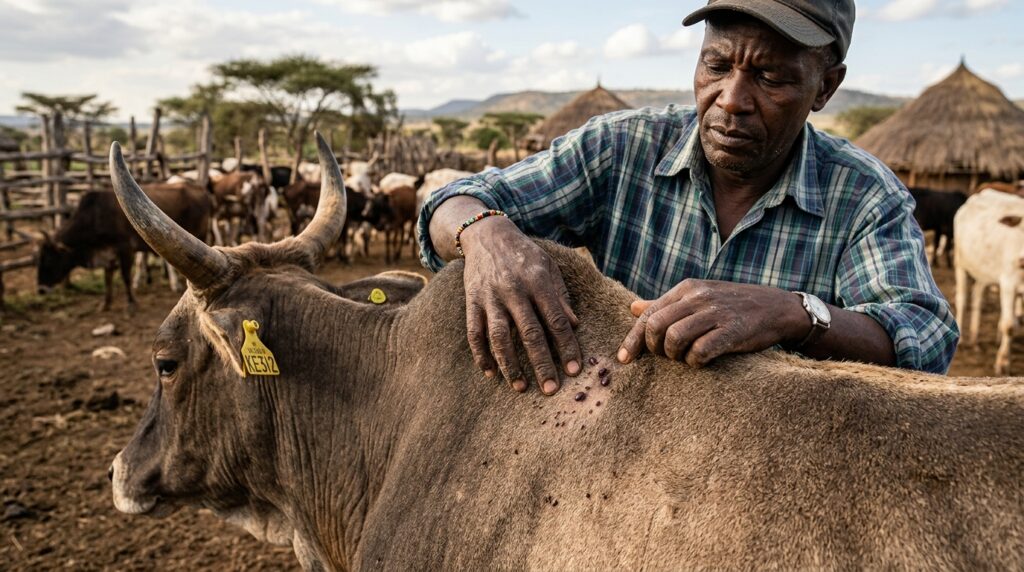
If you own cattle in Nigeria, Ghana, Kenya, or South Africa, there is a good chance ticks are on your animals right now. Not maybe. Not possibly. Right now, as you read this, ticks are feeding on your cattle, laying eggs in your grazing land, and setting up the next generation of infestation that will still be there next season and the season after that unless you do something deliberate about it.
That is not an exaggeration. It is the reality of cattle farming across sub-Saharan Africa where tick pressure is year-round, where the diseases ticks transmit kill more cattle than almost any other single cause, and where most farmers treat ticks reactively after animals are already sick rather than preventively before the damage is done.
This article is for the cattle farmer who is tired of losing animals they cannot afford to lose, spending money on treatments that come too late, and watching a herd that should be growing and thriving slowly decline instead.
What Ticks Are Actually Doing to Your Cattle
Most farmers think of ticks as an irritation. A nuisance that makes cattle uncomfortable and requires occasional dipping. The reality is considerably more serious than that.
Ticks cause damage to cattle through three distinct mechanisms and understanding all three changes how urgently you approach tick control.
Direct Physical Damage
Heavy tick burdens cause direct physical harm through blood loss. A single engorged female tick consumes approximately 0.5 to 3ml of blood during her feeding period. That sounds small until you consider that a heavily infested animal can carry hundreds of ticks simultaneously. The cumulative blood loss causes anaemia, weight loss, reduced milk production in dairy cattle, poor growth rates in young stock, and general condition decline that reduces the market value of beef animals.
Tick feeding also causes skin wounds that become infected with bacteria and screwworm flies in tropical conditions. Tick attachment sites on the ears, udder, and around the eyes are particularly prone to secondary infection that causes significant animal distress and can lead to permanent tissue damage.
Disease Transmission
This is where ticks move from being a serious nuisance to being a genuine killer of African cattle.
East Coast Fever, caused by the protozoan parasite Theileria parva and transmitted by the brown ear tick Rhipicephalus appendiculatus, kills more cattle in East Africa than any other disease. In Kenya alone it causes an estimated 1.1 million cattle deaths annually. Affected animals show high fever, swollen lymph nodes, difficulty breathing as fluid accumulates in the lungs, and death within two to four weeks of infection in susceptible animals.
Anaplasmosis and Babesiosis, both transmitted by various tick species across Nigeria, Ghana, and South Africa, cause severe haemolytic anaemia where the parasite destroys red blood cells faster than the animal can replace them. Affected cattle show pale mucous membranes, red or brown urine, high fever, and rapid deterioration. Mortality in unvaccinated naive animals can reach 50 percent or higher in a disease outbreak.
Heartwater, transmitted by Amblyomma ticks across sub-Saharan Africa, affects cattle, sheep, and goats and causes neurological symptoms including circling, high stepping gait, and convulsions followed by death in acute cases.
Reduced Productivity
Even without clinical disease, cattle carrying a significant tick burden consistently underperform compared to tick-free animals of the same breed and nutrition level. Studies across East and West Africa show that effective tick control improves weight gain by 15 to 25 percent in beef cattle and increases milk production by 10 to 20 percent in dairy cows compared to untreated animals under the same management conditions. That productivity gap represents real income that tick-infested cattle are costing their owners every single day.
Knowing Your Enemy: The Ticks That Matter Most in Africa
Different tick species cause different disease problems and understanding which species are present on your farm helps you target your control programme correctly.
Rhipicephalus microplus and Rhipicephalus decoloratus, the blue tick species, are the most widespread cattle ticks across Nigeria, Ghana, and South Africa. They are one-host ticks meaning all life stages, larva, nymph, and adult, feed on the same animal. This makes them easier to control with acaricide treatments because all stages are present on the animal simultaneously. They transmit Babesiosis and Anaplasmosis.
Rhipicephalus appendiculatus, the brown ear tick, is the primary vector of East Coast Fever in Kenya and East Africa. It is a three-host tick meaning each life stage drops off the animal between feeds and develops on the ground before finding a new host. This ground-dwelling behaviour makes it harder to control with on-animal treatments alone because the majority of the population is off the animal in the environment at any given time.
Amblyomma variegatum, the tropical bont tick, is widespread across Nigeria, Ghana, and parts of East Africa. It transmits Heartwater and causes severe skin lesions called Amblyomma dermatitis at attachment sites. It is a three-host tick with a strong preference for the soft skin areas of the dewlap, udder, and inner thigh.
Step-by-Step Tick Control That Actually Works
Acaricide Dipping and Spraying
Acaricide treatment applied directly to the animal is the primary tool for reducing tick burdens on African cattle farms. The method of application, the choice of acaricide, and the treatment interval all determine whether your programme works or fails.
Amitraz 12.5 percent concentration is one of the most effective and widely available acaricides for cattle tick control in Nigeria, Ghana, Kenya, and South Africa. It is sold under brand names including Triatix and Taktic. Dilute at 2ml per litre of water for spray application or 2.5ml per litre for plunge dip use. For spray application using a knapsack sprayer, thoroughly wet the entire animal from head to tail including the underside, inner legs, udder or scrotum, ears, and around the eyes where ticks prefer to attach. Every part of the skin surface must be reached. Dry spraying that misses the inner thigh and ear areas leaves the highest-burden attachment sites untreated.
Apply amitraz treatment every 14 days during peak tick season and every 21 days during low-pressure seasons. In Kenya where East Coast Fever pressure from brown ear tick is high, maintain a 14-day interval year-round on farms in endemic zones.
Cypermethrin 10 EC diluted at 1ml per litre of water is a more affordable alternative available at most agro-chemical dealers across Nigeria and Ghana. Apply by thorough spraying of the entire animal surface as described above. Cypermethrin is a pyrethroid that works through contact with the tick’s nervous system and provides rapid knockdown of adult ticks on the animal surface. Repeat every 14 days.
Deltamethrin pour-on formulations are applied directly along the back line of the animal from poll to tailhead without dilution. Pour-on acaricides are more convenient for farmers without dipping facilities and are available at veterinary suppliers in major Nigerian and Kenyan towns. Apply at the dose stated on the product label based on animal body weight. The active ingredient spreads across the skin surface through the animal’s natural skin oils over 24 to 48 hours after application.
Always rotate between acaricide classes across treatment seasons to prevent resistance development. Ticks in many parts of Africa have developed significant resistance to pyrethroids including cypermethrin and deltamethrin through decades of exclusive use. If you notice reduced tick knockdown after treatment with your usual product, switch to amitraz which works through a different mechanism and to which resistance is less widespread in African tick populations.
Treating the Environment
For three-host tick species like the brown ear tick and Amblyomma, treating animals alone is insufficient because the majority of the tick population is off the animal in pasture and surrounding vegetation at any given time.
Rotational grazing is the most practical environmental control method for African smallholder cattle farmers. Move cattle to a fresh paddock every three to four weeks and leave the vacated paddock ungrazed for at least six to eight weeks. Tick larvae, nymphs, and adults that drop off the animal into the vacated paddock cannot survive indefinitely without a blood meal. Larvae die within two to four months without finding a host. Rotating grazing denies the tick population the continuous host access it needs to maintain large numbers in the environment.
Where paddock infrastructure allows, spray pasture areas around watering points and shade trees with cypermethrin 10 EC at 2ml per litre of water applied as a coarse spray to vegetation surfaces. Ticks concentrate in these areas waiting for hosts and treating these hot spots reduces environmental tick pressure significantly without requiring whole-pasture treatment.
Ear Tick Specific Treatment
For brown ear tick infestations in Kenya and East Africa where ticks concentrate heavily in the ear canal, standard body spray treatment does not adequately reach tick attachment sites deep inside the ear.
Mix amitraz at 2ml per litre of water. Using a small squeeze bottle or syringe without a needle, apply 5ml of the diluted solution into each ear canal of every animal at each treatment interval. Tilt the animal’s head to prevent the solution from running out immediately and massage the base of the ear gently to distribute the treatment inside the canal. This targeted ear treatment in addition to whole-body spray significantly improves East Coast Fever prevention by reducing the primary vector attachment site.
You can also read: Common poultry pests in Nigerian farms and how to treat them
Vaccination as Part of Your Tick Disease Defence
Acaricide treatment controls tick numbers but does not provide protection against tick-borne diseases in animals that are exposed before treatment takes effect or through treatment failures.
In Kenya the East Coast Fever infection and treatment method, commonly called ITM, involves deliberate controlled infection of cattle with Theileria parva followed immediately by treatment with long-acting oxytetracycline to limit the infection to a subclinical level. Animals that survive this controlled infection develop lasting immunity to East Coast Fever. The ITM protocol is administered by trained veterinary personnel and is available through the Kenya Veterinary Vaccines Production Institute and private veterinary practitioners in endemic zones.
For Babesiosis and Anaplasmosis in Nigeria, Ghana, and South Africa, live attenuated vaccines are available through government veterinary services in some states and provinces. Contact your state veterinary office or nearest livestock development authority to confirm vaccine availability in your region and the recommended vaccination schedule for your location.
Vaccination does not replace acaricide treatment. It works alongside it. A vaccinated animal that also receives regular acaricide treatment is protected both from the tick burden itself and from the diseases the ticks carry.
Reading Your Cattle: Signs That Ticks Are Winning
Your cattle tell you when tick pressure is becoming a problem if you know how to read the signs correctly.
A healthy well-managed animal with controlled tick burden maintains a smooth shiny coat, firm body condition, bright eyes, and consistent feed intake. Animals moving in the wrong direction from tick pressure show a rough staring coat even when nutrition is adequate, progressive loss of body condition despite maintained feed intake, pale pink or white mucous membranes in the gums and inner eyelids indicating anaemia, reduced activity and separation from the herd, and in dairy animals a measurable drop in daily milk yield without any change in feed quality or quantity.
Check the mucous membrane colour of your cattle monthly by gently pulling down the lower eyelid and observing the colour of the inner surface. Deep pink to red is healthy. Pale pink is early anaemia. White or very pale is severe anaemia requiring immediate veterinary attention.
Count tick burdens on ten animals across your herd every two weeks during peak season. Count all visible ticks on a defined body area, typically one side of the animal from shoulder to flank. A count of more than five ticks per animal on that area indicates that your current treatment programme is not controlling the population adequately and the interval or product needs to be adjusted.
Why Tick Control Programmes Fail on African Farms
Treating only visibly heavily infested animals and leaving lightly infested ones untreated. Lightly infested animals are reservoirs that maintain the tick population and reinfest treated animals. Every animal in the herd must be treated at every treatment interval without exception.
Using acaricide at below-label concentration to stretch the product further. Sub-lethal acaricide exposure is the primary driver of resistance development in tick populations. Ticks surviving sub-lethal exposure pass resistance genes to the next generation. After several generations of sub-lethal exposure your acaricide stops working entirely and you face a resistant tick population that your current product cannot control at any concentration. Always mix at the correct label rate.
Treating on an irregular schedule based on visible tick counts rather than on a fixed calendar interval. By the time tick numbers are visibly high on animals the population has already been building for weeks. Fixed interval treatment maintains suppression before numbers build rather than reacting after they already have.
Dipping or spraying without adequate coverage of the ear canal, inner thigh, udder, and under the tail. These are the highest-burden attachment sites on the animal and the areas most commonly missed during rushed treatment sessions. Take the time to treat every surface thoroughly at every session.
Conclusion
Ticks are not just a farming inconvenience in Nigeria, Ghana, Kenya, and South Africa. They are a daily drain on your herd’s health, your cattle’s productivity, and your farming income. Every tick feeding on your animal right now is taking something from you, whether that is blood, milk production, weight gain, or in the worst cases the life of an animal you cannot replace easily.
The answer is not complicated but it requires consistency. Choose the right acaricide for the tick species on your farm. Apply it correctly, thoroughly, and on a fixed schedule. Rotate between acaricide classes to stay ahead of resistance. Vaccinate against the tick-borne diseases that kill cattle in your region. Walk your herd regularly and read the signs your animals are giving you.
Start this week. Check your cattle today for tick burdens. Check their mucous membranes. If what you find concerns you, begin your acaricide programme immediately and contact your nearest veterinary officer for advice on tick-borne disease vaccination in your area.
Your cattle are your investment. Protect them like it.



Leave a Reply