How Much Does a Football Academy Cost in Nigeria? (Fees Breakdown)
If you are a Nigerian parent whose child has shown genuine talent and passion for football, one of the first practical questions that comes to mind is how much it is going to cost.
It is a fair question and an important one, but it is also one that is surprisingly difficult to get a straight answer to.
Football academy fees in Nigeria are rarely published openly. Most academies prefer to discuss fees in person or after a trial, which means parents often go into the process without a clear sense of what they are committing to financially.
This article is an attempt to change that by giving you a realistic picture of what football academy costs look like across different types of academies in Nigeria.
Why Fees Vary So Much
Before getting into numbers, it helps to understand why football academy fees in Nigeria vary as dramatically as they do. The variation comes down to several factors.
Location plays a significant role. Academies in Lagos, Abuja, and Port Harcourt generally charge more than academies in smaller cities and states, reflecting the higher cost of operating in those environments.
An academy running a programme in Abakaliki or Owerri will typically charge less than a comparable academy in Lagos simply because their operating costs are lower.
Facilities also drive fee differences. An academy with a well-maintained pitch, a gym, changing rooms, medical support, and proper equipment has real costs attached to maintaining all of that, and those costs are reflected in what they charge. An academy operating on a community pitch with minimal equipment has lower overheads and lower fees.
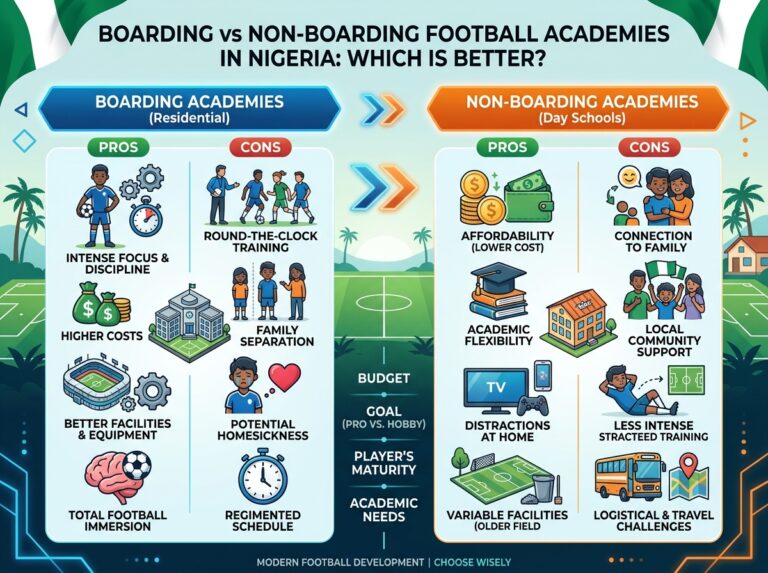
Whether the academy is residential or non-residential is another major factor.
Boarding academies that provide accommodation, meals, and sometimes schooling for their players charge significantly more than day academies where players come for training and go home afterward.
The reputation and track record of the academy also influences pricing. Academies that have consistently produced players who have gone on to professional careers understand the value of what they offer and price accordingly.
Fee Ranges Across Different Academy Types
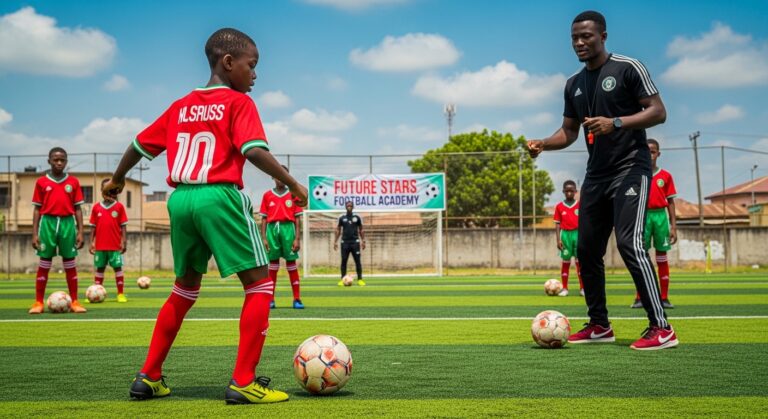
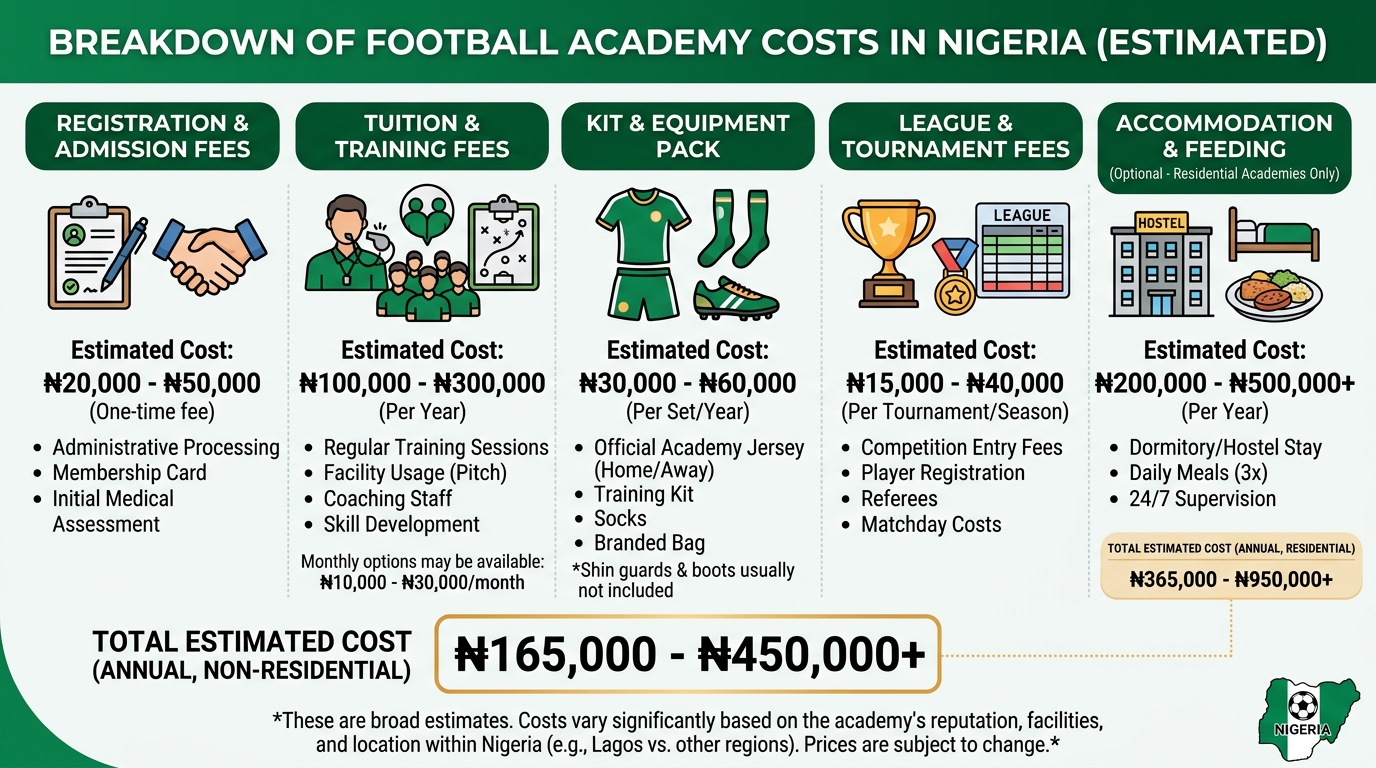
For community and grassroots academies, which form the majority of football development programmes across Nigeria, monthly fees typically fall between 2,000 naira and 10,000 naira. These academies offer structured training, usually three to five sessions per week, and participation in local competitions. The coaching quality varies significantly at this level so it is important to assess each one individually rather than assuming the fee reflects the quality.
For mid-level private academies with better facilities, qualified coaches, and participation in state or regional league competitions, monthly fees generally range from 10,000 naira to 30,000 naira. Some charge termly or annually rather than monthly, which can make the upfront cost feel larger even if the monthly equivalent is comparable. At this level you are typically getting more structured programming, better coaching credentials, and more competitive match opportunities.
For elite private academies with professional-grade facilities, experienced coaching staff, strong competitive programmes, and established pathways to professional football, fees can range from 30,000 naira to 100,000 naira per month or significantly more in some cases. Some of the most prestigious academy programmes in Lagos charge annual fees that run into the millions of naira when accommodation, meals, equipment, and competition costs are factored in.
Residential academies at any level add the cost of accommodation and feeding to the base training fee. This can add anywhere from 20,000 naira to 150,000 naira per month depending on the standard of accommodation and meals provided.
Hidden Costs Parents Should Know About
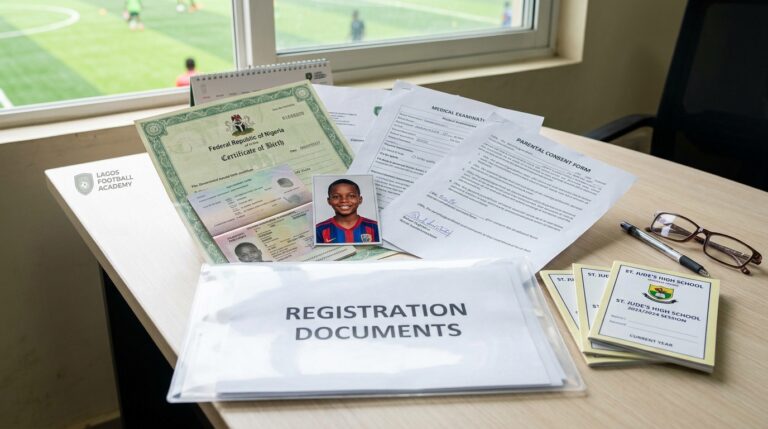
The registration or trial fee is sometimes charged before a player is even admitted. Most reputable academies do not charge for trials, but some charge a one-time registration fee when a player is accepted. This typically ranges from 5,000 naira to 30,000 naira.
Kit and equipment costs are often separate from the training fee. A player joining an academy will usually need to purchase the academy kit, training bibs, boots, shin guards, and sometimes a training bag. Depending on the academy’s requirements, this initial outlay can range from 15,000 naira to 80,000 naira.
Competition and tournament fees may be charged separately when the academy participates in organised leagues or cup competitions. Some academies absorb these costs into the overall fee while others pass them on to parents as they arise.
Medical and insurance costs are something very few Nigerian parents ask about upfront but should. Injuries happen in football and understanding what the academy’s policy is regarding player welfare and medical support before you commit is an important part of making an informed decision.
Transport is another cost that affects day academy players significantly. If the academy is not close to your home, the daily or weekly cost of getting your child to and from training adds up quickly and should be factored into your overall budget.
Free Academies and What They Actually Offer
It is worth addressing free academies specifically because many Nigerian parents either do not know they exist or assume they are not worth considering. Several well-funded free academies operate across Nigeria, supported by corporate sponsors, state governments, and football development organisations.
These academies do not charge training fees and some cover kit and equipment as well. The quality varies just as it does among paid academies, so the same evaluation criteria apply. A well-run free academy with qualified coaches and organised competition is a genuinely valuable opportunity that should not be dismissed simply because it costs nothing.
Making the Decision That Is Right for Your Family
The most important principle when evaluating football academy costs is sustainability.
An academy fee that stretches your family budget to the point of genuine hardship is not the right choice, regardless of how good the academy is.
Football development takes years, not months, and a financial commitment you cannot sustain will eventually force you to withdraw your child from the programme at a point that may not be right for their development.
Choose an academy whose fees you can pay consistently over a period of at least two years without it creating a crisis in your household. A good academy at a price you can sustain will do more for your child’s development than an elite academy whose fees you are struggling to pay every month.
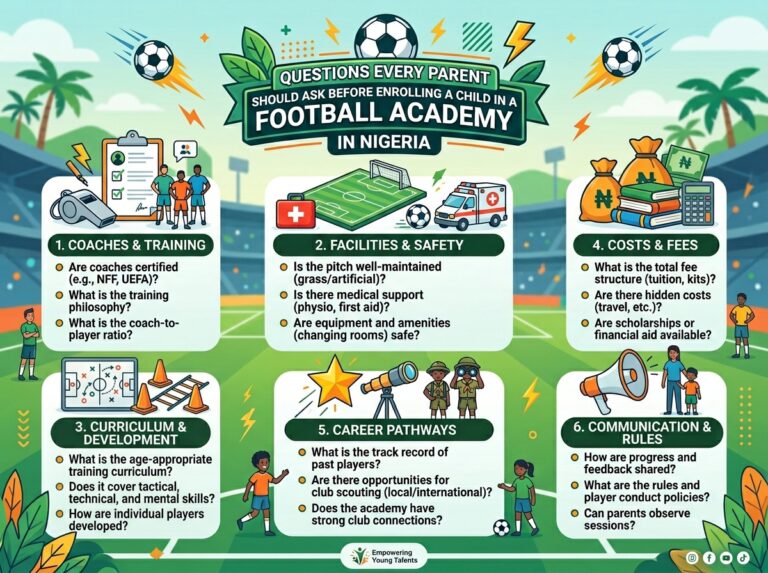
Ask the academy clearly about all costs before committing. Ask what is included in the training fee, what is charged separately, what happens if fees are paid late, and whether there are scholarship or bursary options available for players who demonstrate exceptional ability. A transparent academy that answers these questions clearly and honestly is one that respects the families it works with.
Your child’s football journey is a long one. Start it on a financial footing that allows the whole family to support it properly.
Written for Findin.com.ng | Parent Guides