How Long Should Football Boots Last Before Replacing Them?
One of the most common questions Nigerian football parents ask, usually while staring at a pair of boots that look like they have been through a war, is whether it is time to replace them or whether they still have life left in them.
And one of the most common questions young Nigerian players ask is how to convince their parents that yes, it genuinely is time for new boots, not just a desire for something newer and cooler.
This guide answers both questions honestly.
The Honest Answer on Boot Lifespan
There is no single number that applies to every boot in every situation. A boot’s lifespan depends on the quality of the boot itself, the surface it is used on most frequently, how often it is used, how well it is maintained, and the intensity of the activity it is put through.
That said, here are realistic lifespan expectations for genuine football boots across different usage patterns in the Nigerian context.
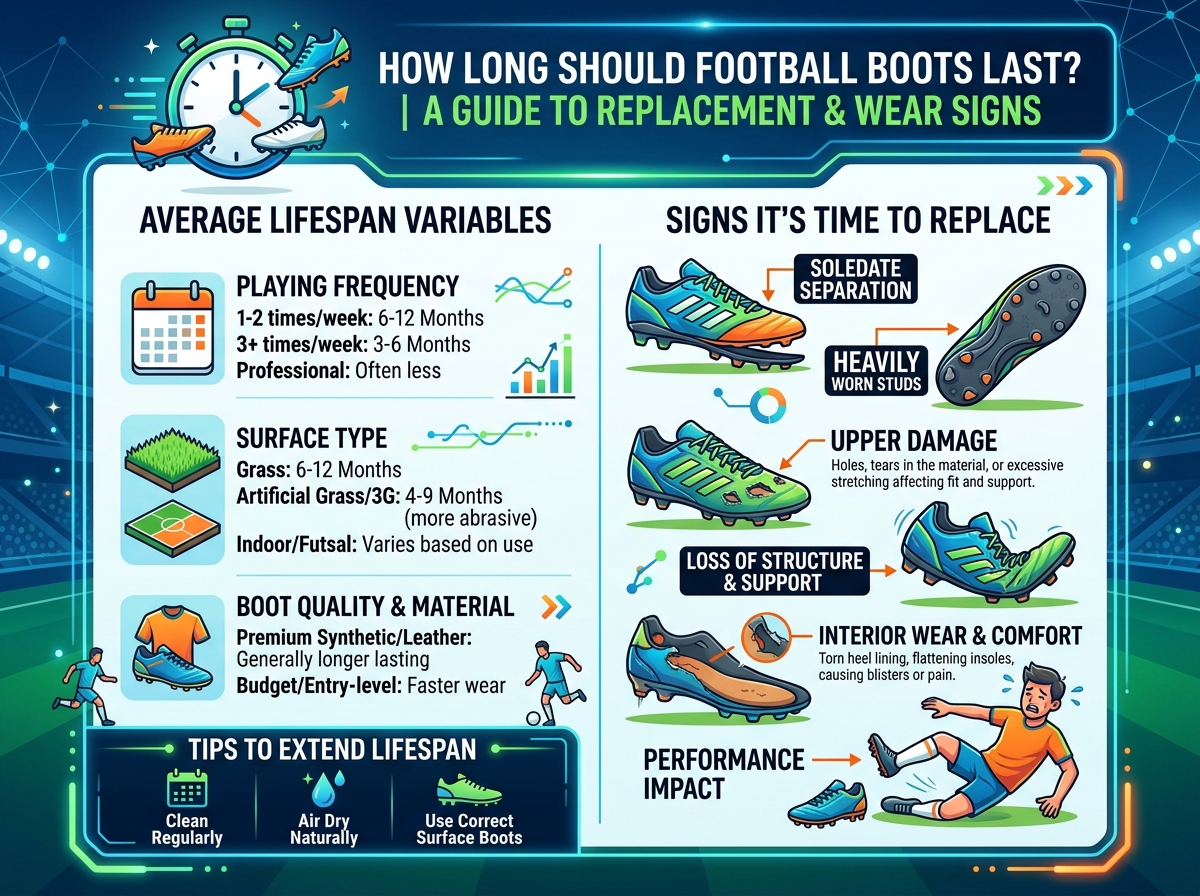
A player training three to four times per week and playing competitive matches on weekends should expect a genuine mid-range boot to last between eight and fourteen months with proper care.
Elite boots at the same usage level may last slightly less because their emphasis on lightweight performance sometimes comes at the cost of long-term durability.
Entry level genuine boots at the same usage level typically last six to ten months before performance begins to deteriorate noticeably.
A player training less frequently, two sessions per week with occasional matches, can reasonably expect boots to last eighteen months to two years before replacement becomes necessary, again with proper maintenance.
These are realistic ranges, not guarantees. A boot used primarily on artificial turf will wear differently from one used on natural grass.
A player who drags their feet during movement will wear through the toe area of an upper faster than one whose technique keeps the foot properly elevated.
Nigerian conditions including hard compacted pitches and the dust of the dry season create specific wear patterns that may accelerate deterioration in certain boot types.
Signs That Boots Need Replacing
Rather than relying purely on time as a guide, knowing the specific signs that indicate a boot has genuinely reached the end of its useful life gives you a more accurate basis for the replacement decision.
Soleplate separation is the clearest sign that a boot needs immediate replacement. When the soleplate begins separating from the upper, even at a single point, the structural integrity of the boot is compromised. Continuing to train in a boot with a separating sole creates injury risk because the boot can no longer provide consistent support during the lateral movements and sudden direction changes that football demands. Soleplate separation is not repairable in any meaningful long-term sense and a boot showing this sign needs to be replaced promptly.
Stud wear on firm ground boots becomes a replacement indicator when studs have worn down to the point where they can no longer provide adequate grip on natural grass. Run your thumb across the studs and compare the height and sharpness of the stud tip to what it was when the boot was new. Significantly worn studs that have become flat or rounded rather than maintaining their original profile are no longer doing their job and the boot needs either new studs where the model allows replacement or full replacement where it does not.
Upper deterioration that has progressed to cracking, significant thinning, or areas where the material has worn through entirely compromises both the boot’s performance and its ability to protect the foot. Small surface scuffs on a synthetic upper are cosmetic and do not affect performance. Deep cracks that penetrate the upper material, areas where the upper has worn thin enough to feel significantly different from surrounding areas, or any point where the foot can be seen or felt through the upper material are signs that the boot’s useful life is ending.
Loss of internal cushioning and support is a less visible but equally important sign. The midsole and internal padding of a boot compress over time with repeated use and eventually reach a point where they no longer provide the cushioning and support they did when new. A boot that has reached this point feels noticeably harder and less supportive than it did when new. Players sometimes describe this as the boot feeling flat or dead underfoot. This loss of cushioning increases the impact transmitted to the foot and lower leg during training and can contribute to overuse injuries if the boot continues to be used.
Persistent discomfort that was not present when the boot was new is worth taking seriously as a replacement indicator. A boot that fit correctly and felt comfortable when purchased but now creates consistent discomfort in specific areas may have deformed structurally in ways that are no longer serving the foot well. This is particularly relevant for growing players whose feet have grown out of a boot that once fit correctly.
The Growing Foot Problem
For Nigerian parents of young players whose feet are still growing, the replacement decision is complicated by the fact that growth rather than wear is often the reason a boot needs to be replaced.
A ten year old’s feet may grow a full size or more within a single year, meaning that boots purchased at the beginning of the year may be genuinely too small before they have worn out.
The temptation to buy boots with significant extra room to accommodate growth and extend the time between purchases is understandable given the cost involved. Resist it.
A boot with too much space in the toe box reduces control, increases the risk of blisters in unexpected areas, and changes how the foot interacts with the ball in ways that are counterproductive for technical development.
For young players in active growth phases, accept that boot replacement may need to happen more frequently than wear alone would require and budget accordingly.
A correctly fitting boot that is replaced every eight to ten months because the foot has grown is a better investment in your child’s development than a boot bought two sizes too large that lasts two years but compromises their technique and comfort throughout.
When Repair Is Worth Considering
Some boot issues are repairable and worth repairing rather than triggering immediate replacement. A loose stud on a boot that is otherwise in good condition can be replaced inexpensively by a cobbler or sports repair shop.
Minor stitching failures at non-structural points on the upper can sometimes be repaired effectively. Insoles that have worn out can be replaced with aftermarket insoles that restore cushioning to a boot whose upper and soleplate are still in good condition.
What is not worth repairing is a boot with soleplate separation, significant upper deterioration, or structural deformation. These issues reflect the boot having genuinely reached the end of its useful life and attempting to repair them produces results that do not last and that may not adequately protect the player during training.
The rough guide is that repair is worth considering when the issue is isolated and the rest of the boot remains in good condition. When the issue is one of several signs of general deterioration, replacement is the right decision.
Making the Boot Budget Work Across Replacements
For Nigerian families managing the cost of keeping a developing academy player properly equipped, the replacement cycle is a budget planning reality worth thinking about proactively rather than reactively.
If your child trains intensively and you are buying mid-range genuine boots, budget for replacement approximately every twelve months as a planning assumption.
If your child is in an active growth phase, shorten that to every eight to ten months. Build that replacement cost into your annual football budget rather than treating each replacement as an unexpected expense.
Buying at the right time of year also helps manage cost. Boot prices on platforms like Jumia and through retailers like AFA Sports sometimes drop around major football events or at the end of the European football season when new models are released and previous season stock is discounted.
Buying during these periods rather than as an emergency replacement when boots have already failed gives you access to better prices and more considered choices.
The goal is never to squeeze the last possible day out of a boot that has genuinely reached the end of its useful life.
A player training in boots that are no longer performing properly is not getting the full benefit of their training and may be increasing their injury risk in ways that are not immediately obvious.
Replace boots when they need replacing and think of it as maintaining the equipment that makes proper development possible.
Written for Findin.com.ng | Player Guides