Boarding vs Non-Boarding Football Academies in Nigeria: Which is Better?
When Nigerian parents begin seriously researching football academies for their child, one of the earliest and most consequential decisions they face is whether to go for a boarding academy or a day academy.
It is a decision that affects not just the child’s football development but the entire family’s routine, finances, and emotional life for however long the child remains in the programme.
There is no universally correct answer. The right choice depends on the age of the child, the quality of the specific options available, the family’s financial situation, and honestly, the temperament and maturity of the player themselves.
What this article will do is give you a clear picture of what each option actually involves so you can make the decision with full information rather than assumptions.
What Boarding Academies Actually Look Like in Nigeria
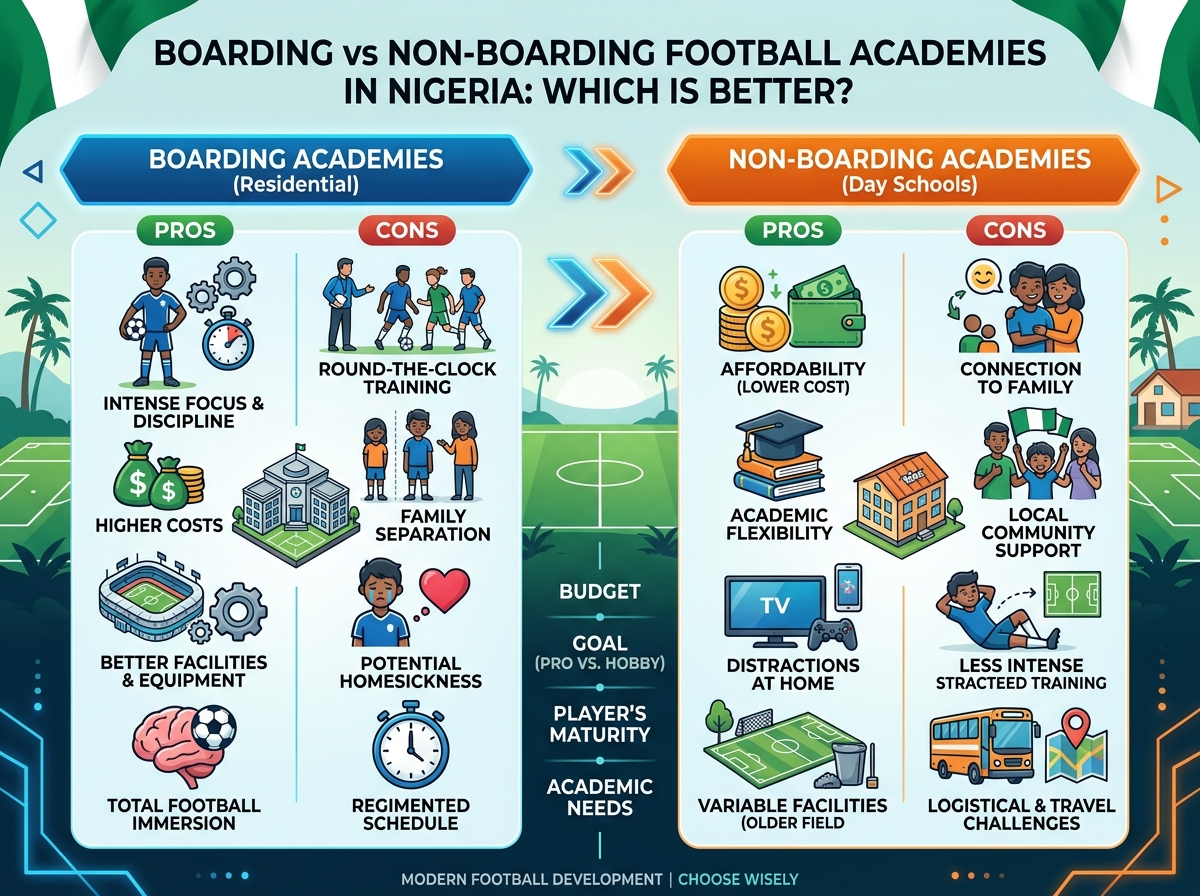
A boarding football academy in Nigeria is a residential programme where players live on the academy premises, train daily, eat together, and in many cases attend school either within the academy or at a nearby institution the academy is partnered with. The player’s entire daily life is structured around football development.
The best boarding academies in Nigeria run genuinely professional operations. Players wake up to structured morning routines, train in the morning and sometimes again in the afternoon, attend academic classes, eat meals designed with their physical development in mind, and live in a supervised environment with other serious young players.
The exposure to that level of structure and seriousness, sustained over months and years, produces a different kind of player from one who trains a few times a week and goes home.
The reality at less well-run boarding academies can look quite different. Facilities that were described as professional turn out to be basic.
Meals are inconsistent. Academic support is minimal or nonexistent. Supervision is loose. Parents who did not visit before enrolling their child sometimes discover these gaps only after their child has already settled in and disruption feels costly.
This is why visiting any boarding academy in person, speaking to current residents and their parents, and verifying conditions independently before committing is not optional. It is essential.
What Day Academies Actually Look Like in Nigeria
A day academy, sometimes called a non-residential or commuter academy, is a programme where players come for training sessions, typically three to five times per week, and return home afterward.
The player lives at home, attends their regular school, and integrates football training into a life that also includes family, community, and normal childhood and adolescent experiences.
Day academies make up the majority of football development programmes across Nigeria.
They range from grassroots community programmes with modest facilities to well-organised private academies with qualified coaches, proper pitches, and competitive match programmes. The variation in quality is enormous so the name tells you very little about the actual standard of what is on offer.
The training hours at a day academy are significantly fewer than at a boarding academy.
A player training five days a week for two hours per session is getting ten hours of structured football development weekly. A boarding player training twice daily is potentially getting twenty or more hours.
Over the course of a year that gap compounds into a significant difference in total development time.
The Case for Boarding Academies
The primary argument for a boarding academy is immersion. Football development at the highest level requires total commitment and the boarding environment creates conditions for that commitment that a day programme simply cannot replicate.
When a young player is surrounded by other serious players every day, when football is the central organising principle of their daily life, when they are coached by professionals who see them not just during training but across multiple contexts throughout the day, the pace of development tends to accelerate.
The best boarding academies in Africa and globally operate on this principle and the results speak for themselves.
There is also the question of equalising opportunity. A talented player from a family in a rural area of Ebonyi State may have very limited access to quality day academy programmes locally.
A boarding academy that offers scholarships or affordable fees gives that player access to development infrastructure that their geography would otherwise deny them. For players in this situation, a boarding academy is not just a preference. It may be the only realistic pathway to serious development.
The discipline and independence that boarding life develops in young players is also worth considering.
Players who learn to manage their time, live with teammates, handle separation from family, and operate within a structured institutional environment often develop maturity and resilience that serves them well throughout their playing careers and beyond.
The Case for Day Academies
The most important argument for a day academy is age appropriateness.
Child development experts and football development professionals broadly agree that very young players, particularly those under the age of twelve or thirteen, benefit more from remaining in a stable home environment than from being placed in residential programmes, regardless of how good those programmes are.
Young children need their parents, their family routines, and the security of home in ways that matter for their overall development as human beings, not just as footballers. Separating a young child from their family for the sake of football development before they have the emotional maturity to handle that separation well can create problems that outweigh the football benefits.
For older teenagers who are emotionally ready for the experience, the calculus changes. But for younger players, a high-quality day academy that allows the child to develop within the security of family life is often the wiser choice even if a boarding option of similar quality is available.
Day academies also allow parents to remain closely involved in their child’s development in ways that boarding arrangements make difficult.
You can watch training sessions, build a relationship with the coaching staff, monitor your child’s progress directly, and respond quickly if something is not going well.
That visibility and involvement matters, particularly in a country where not every academy operates with the transparency and accountability that families deserve.
The financial argument for day academies is also significant. Boarding academies cost substantially more than day programmes when accommodation and feeding are factored in.
For families who are already making sacrifices to support a child’s football development, the additional cost of a boarding placement may simply not be sustainable over the years that serious development requires.
Age as the Deciding Factor
If there is one principle that should guide this decision above all others, it is that younger players almost always belong at home and older teenagers can genuinely benefit from a boarding environment if the right programme is available and affordable.
A rough guideline that experienced football development professionals often suggest is that residential programmes become genuinely appropriate from around age fourteen or fifteen, when players have developed sufficient emotional maturity to handle the separation from family and the demands of institutional life without it becoming a source of distress that undermines their development.
Below that age, prioritise keeping the child at home in a stable family environment while finding the best day academy available within a reasonable distance. Above that age, if a genuinely high-quality boarding academy is accessible and affordable, it becomes worth serious consideration.
Making the Decision for Your Child Specifically
Beyond the general principles, this decision needs to be made with your specific child in mind. Some thirteen year olds are emotionally mature enough to thrive in a boarding environment. Some sixteen year olds are not ready. You know your child better than any general guideline does.
Have an honest conversation with your child about what they want and what they feel ready for. A player who genuinely wants the boarding experience and is excited about the challenge will adapt differently from one who is going because their parents decided it was best. Buy-in from the player themselves matters enormously for how well the transition goes.
Whatever you decide, make sure the choice is driven by what genuinely serves your child’s overall development as a person and as a player, not by status, peer pressure from other football parents, or assumptions about what serious commitment is supposed to look like.
The best football academy for your child is the one where they will be safe, well-coached, appropriately challenged, and genuinely happy to show up and work every single day. Whether that academy has beds or not is secondary to those fundamentals.
Written for Findin.com.ng | Parent Guides